
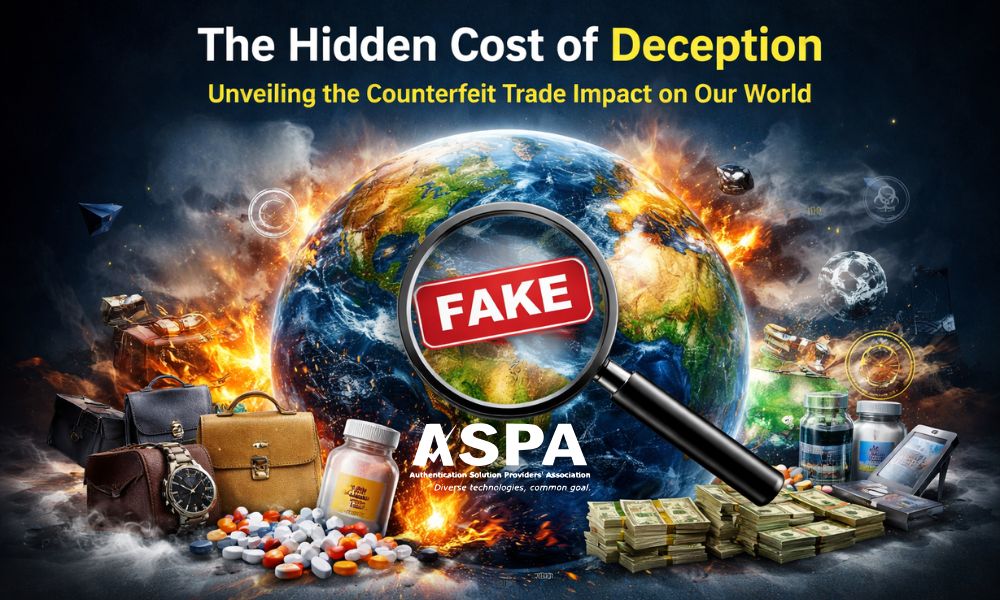
In an era of rapid e-commerce and globalized supply chains, the Counterfeit Trade Impact has evolved from a back-alley nuisance into a trillion-dollar parasite on the global economy. While a “knock-off” designer bag or a cheap pair of sneakers might seem like a victimless bargain, the reality is far more sinister. Beneath the surface of these discounted deals lies a sophisticated criminal infrastructure that drains national treasuries, destroys millions of legitimate jobs, and—most alarmingly—puts human lives at risk. Organizations like ASPA Global (Authentication Solution Providers’ Association) are now at the forefront of this battle, working to protect the integrity of brands and the safety of consumers worldwide.
How Is Counterfeit Trade Quietly Damaging the Global Economy?
The global economy operates on a foundation of trust, innovation, and legal compliance. Counterfeit trade acts as a massive “black hole” that sucks value out of this system. According to recent data from the OECD and EUIPO, the trade in fake goods accounts for roughly 2.5% of global trade, valued at nearly $467 billion annually.
- Tax Revenue Loss: Governments lose billions in unpaid VAT, customs duties, and corporate income taxes. This is money that would otherwise fund public infrastructure, healthcare, and education.
- Stifling Innovation: When intellectual property (IP) is stolen, companies lose the incentive to invest in Research & Development (R&D). Why spend years and millions developing a product if a pirate can replicate it in days for a fraction of the cost?
- Funding Organized Crime: Evidence from Interpol and UNODC shows that profits from counterfeiting often fund more dangerous activities, including human trafficking, money laundering, and even terrorism.
What Is the Real Cost of Counterfeit Products to Legitimate Brands?
For a legitimate brand, the damage caused by fakes goes far beyond a simple loss of a sale. It is an assault on their most valuable asset: Reputation.
- Brand Erosion: When a consumer unknowingly buys a fake product and it fails or breaks, they don’t blame the counterfeiter—they blame the brand whose logo is on the box. This leads to a permanent loss of customer loyalty.
- Increased Operational Costs: Brands must spend millions on legal battles, takedown notices for online marketplaces, and advanced security packaging to stay one step ahead of forgers.
- Market Dilution: For luxury and high-end brands, exclusivity is everything. The flood of cheap imitations “cheapens” the brand image, making the original less desirable to its target demographic.
Are Counterfeit Goods Putting Consumer Safety at Serious Risk?
This is perhaps the most critical aspect of the Counterfeit Trade Impact. Counterfeiters do not follow safety regulations, labor laws, or quality control standards. They use the cheapest, often most toxic materials available.
- Pharmaceuticals: Fake medicines may contain too much, too little, or no active ingredients at all. In some cases, they have been found to contain toxic fillers like floor wax, lead-based paint, and even rat poison.
- Electronics: Counterfeit phone chargers and lithium-ion batteries lack the internal “cut-off” switches required by law, leading to house fires and explosions.
- Automotive Parts: Substandard brake pads, airbags, and engine components are “ticking time bombs” on the road, directly causing fatal accidents.
- Cosmetics and Toys: Fake perfumes often contain high levels of methanol and bacteria, while counterfeit toys may use lead-based paints or small parts that pose choking hazards to children.
The Role of ASPA Global in Protecting Markets
In the fight against this global menace, the Authentication Solution Providers’ Association (ASPA Global) plays a pivotal role. As a self-regulated, non-profit organization, ASPA is dedicated to building a robust authentication ecosystem.
ASPA Global works across four key pillars to mitigate the Counterfeit Trade Impact:
- Awareness: Educating consumers and businesses on how to identify fakes.
- Advocacy: Working with governments and industry bodies to push for stricter anti-counterfeiting laws.
- Research: Analyzing global trends to stay ahead of the evolving tactics used by counterfeiters.
- Innovation: Encouraging the adoption of high-tech solutions like QR codes, holograms, and “track and trace” technologies.
By fostering collaboration between technology providers and brand owners, ASPA helps ensure that “genuine” remains the standard, not the exception.
How Does the Counterfeit Trade Affect Jobs and Local Industries?
The impact on the workforce is devastating. In the European Union alone, it is estimated that over 670,000 jobs are lost annually due to the presence of counterfeit goods in the market.
“Counterfeiting is a job killer. Every fake item sold represents a stolen hour of work from a legitimate employee who pays taxes and supports their local economy.”
When local industries cannot compete with the artificially low prices of fakes, factories close, and skilled artisans lose their livelihoods. This creates a ripple effect where the “hidden” economy of fakes grows at the expense of the “real” economy that sustains families and communities.
Who Ultimately Pays the Price for Cheap Counterfeit Products?
While the initial buyer might think they’ve saved $50 on a “super-fake” watch or $20 on a designer shirt, the collective price paid by society is far higher.
| Stakeholder | The True Price They Pay |
| The Consumer | Risks of physical injury, health issues, and loss of money on a non-functional product. |
| The Worker | Loss of employment, suppressed wages, and exposure to unsafe working conditions in illicit factories. |
| The Government | Massive deficits in tax revenue, leading to poorer public services. |
| The Environment | Illegal factories rarely follow environmental laws, dumping toxic chemicals into local water supplies. |
Conclusion:
The Counterfeit Trade Impact is a global crisis that requires a unified response. It is not just about protecting the profits of big corporations; it is about protecting the health of our children, the safety of our roads, and the stability of our global economy.By supporting organizations like ASPA Global and making the conscious choice to buy only from authorized retailers, we can begin to starve the illicit trade of its oxygen. The next time you see a “deal” that looks too good to be true, remember that the true cost of a counterfeit product is never written on the price tag.
 Counterfeit Trade Impact | ASPA Global